Jefferson County, Colorado
Lakewood Zoning Code Special Election
UPDATE - April 3, 2026
BALLOTS MUST BE IN A DROP BOX BY 7 PM ON TUESDAY, APRIL 7. Closest drop boxes: Lakewood Library (10200 W. 20th Ave.), Jeffco Public
Health (645 Parfet St.), and Red Rocks Community College (13302 Fox Run at the Environmental Tech Building). Do NOT take it to the Jeffco Admin building (aka Taj Mahal).
Vote "YES" "YES" "YES" "YES" to Repeal New Zoning Ordinance
There are four questions on the ballot, each to repeal a different part of the new zoning code. To repeal the new zoning code, vote YES on all four.
The Truth about the Special Election
- The "YES" campaign is non-partisan, with volunteers from across the political spectrum.
- The "YES" campaign has no dark money and is funded almost entirely by contributions from Lakewood. It's a grassroots campaign launched by long-time Lakewood residents and made up entirely of volunteers. The other side has raised five times as much money - almost all of it from special interest group from outside Lakewood - with $165,000 coming from just four large donors, including $75,000 from a group in Houston, TX, and $16,000 from the Chicago-based National Realtors Association. Follow the money
- Lakewood needs to update its zoning code, but it needs to get it right. Repealing the new code simply forces Lakewood to rewrite it so that it actually meets the stated goals of increasing affordability and protecting the character Daniels Gardens, Mountain View and Lakewood's many other amazing neighborhoods. If the code is repealed, City Council can pass a revised code six months later.
- The new code will do nothing to increase housing affordability in Lakewood. There is nothing that requires affordable housing, or even mid-priced housing, to be built. Minneapolis passed a similar zoning code to allow higher density in single-family neighborhoods, and it failed. Same in Portland, OR, and that city is in a serious economic decline.
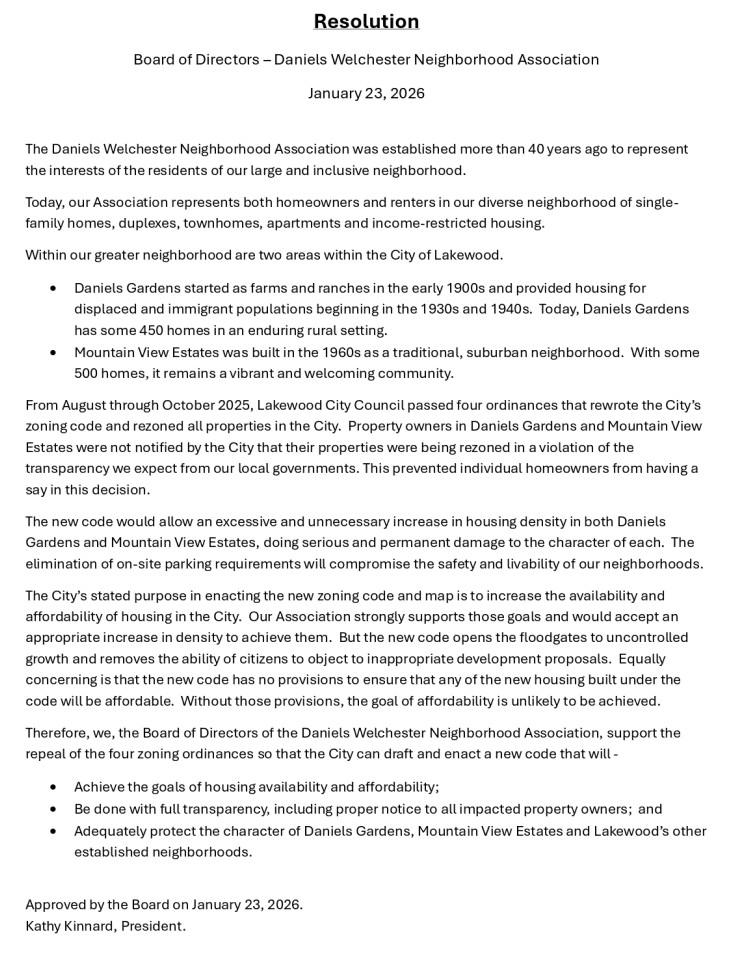
The Board of DWNA approved a resolution (see below) supporting a "YES" vote on all four ballot questions, which would repeal the new zoning code. If the YES votes win, the old code would remain in effect. We would then ask City Council to work with neighborhood representatives to write a new code that will be effective in achieving the City's important goals of housing availability and affordability while maintaining the character of Daniels Gardens, Mountain View and Lakewood's other great, established neighborhoods.
Why the new code should be repealed and replaced
- The new code allows the kind of higher density housing that has popped up in Denver over the past 10 years to come to Lakewood.
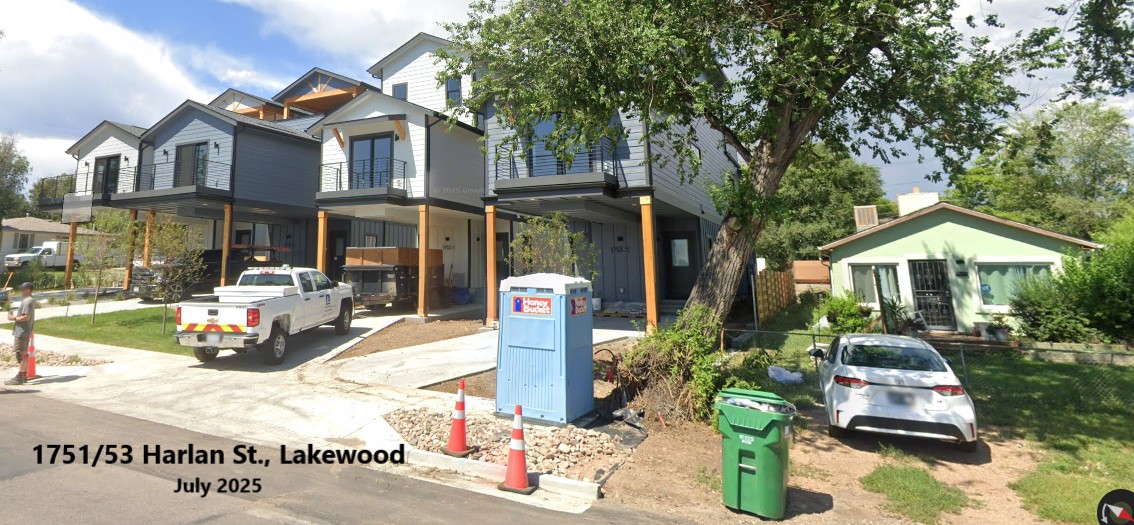
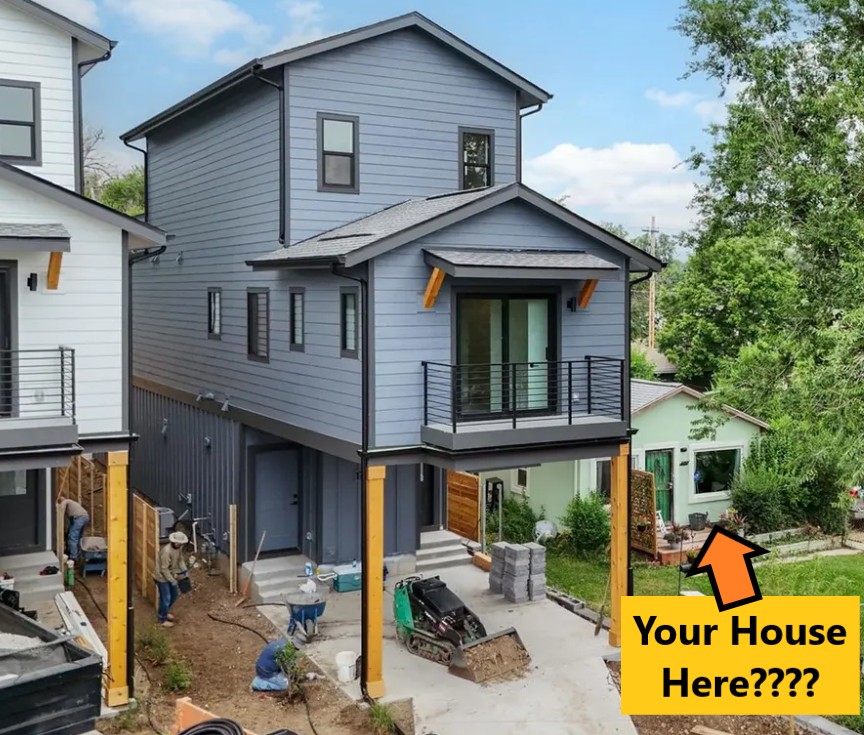
- The new code will permit developers to "urbanize" Lakewood by allowing houses in established neighborhoods to be converted into apartment buildings and allowing developers to purchase your neighbor's house, scrape it and build multiple houses on the lot like the houses pictured below. Those new houses could be built just five feet from your property line if you live in Mountain View and 10 feet if you live in Daniels Gardens.
- There is NOTHING in the new code that requires - or even incentivizes - developers to build any affordable or "missing middle" housing. It just makes it easier and more profitable for developers to buy up an affordable $400,000 home, bulldoze it and build one or more unaffordable $1 million homes on the lot. That's exactly what happened with the development pictured below. "Affordability" is a cover story. The new code should be replaced with one that requires developers to either build affordable housing or requires them to give a portion of that extra profit to the city to fund affordable housing projects as Seattle, Boulder, Boston, Denver and other cities have done.
- The new code eliminates minimum parking requirements. Houses converted to apartment buildings and new homes built in established neighborhoods will NOT be required to have any off-street parking, clogging neighborhood streets with parked cars.
- There is a better way to provide more and more affordable housing in Lakewood while maintaining the character of the city and its established neighborhoods instead of turning it into an extension of Denver. If voters repeal the new code, City Council cannot replace it for six months, giving DWNA and other neighborhood groups the opportunity to work cooperatively with the City to create a code that will promote affordability and address the city's housing needs.
Go to lakewoodcitizensalliance.org to learn more.
Board Resolution
This is the resolution passed by the DWNA Board of Directors. It calls for repealing the new code and enacting a code that will achieve the goals of more and affordable housing while preserving the character of our neighborhoods and other established neighborhoods in Lakewood.
Background
A group of Lakewood citizens volunteered their time to collect some 16,000 signatures on petitions to give Lakewood voters the opportunity to decide whether they want to eliminate single-family neighborhoods in the city by allowing developers to build multi-family housing on any lot in any neighborhood. Those buildings can be 35 feet tall and 5,000 square feet, even next to one-story houses. And buildings less than 4,000 sq. ft. can be built with NO PARKING, so all parking would be on the street.
What's at stake
If you own a home in Lakewood, your house and your neighborhood were rezoned by the City on Oct. 13 without you being notified. A developer can now buy your neighbor's house, scrape it, then build as many housing units that will fit under the new, generous, building standards. It could be one 35-ft-tall building of 4,000 or 5,000 sq. ft. with multiple housing units, including apartments. Or the property can be subdivided into multiple lots with a home built on each. Here's an example of what it could look like with new construction towering over existing houses, disrupting lives, forever changing the character of the neighborhood, and filling the street with parked cars.
This is a development Lakewood approved just last year at 1751/53 Harlan St. Under the new zoning ordinance, this is the kind of housing that will be allowed in neighborhoods around the city.
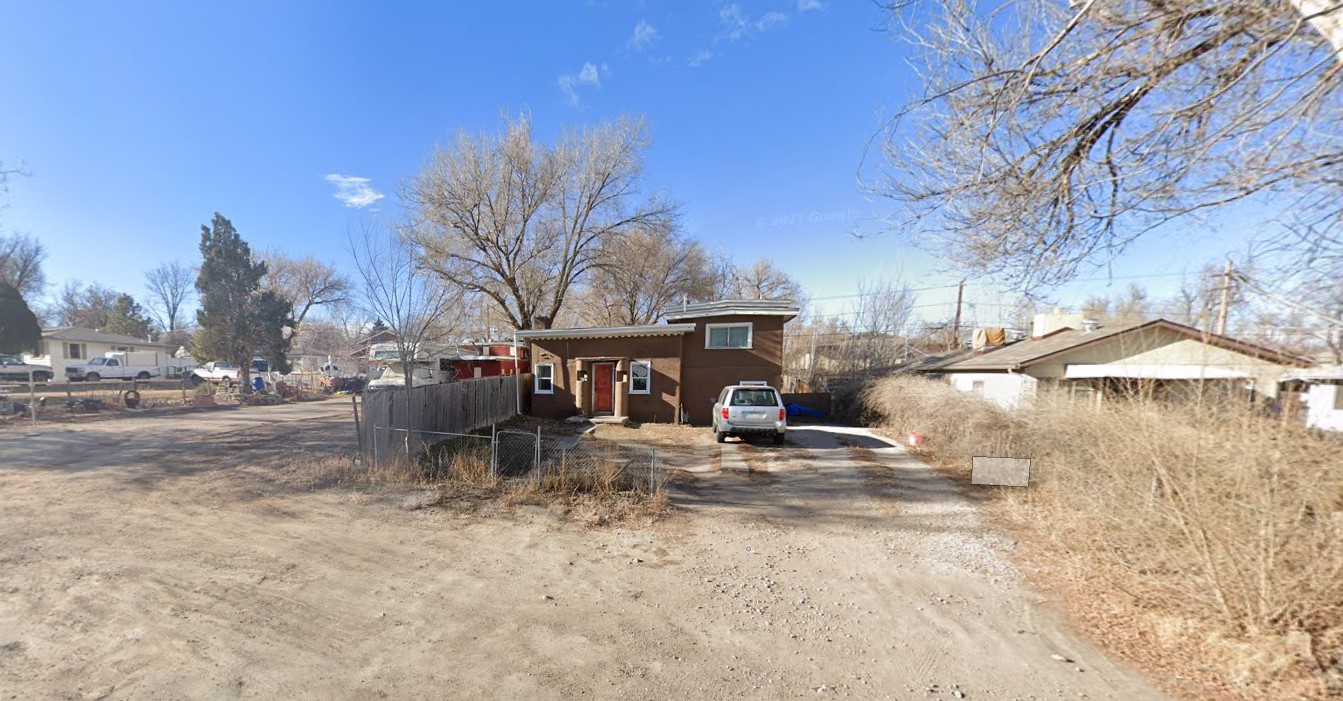
Below Left: A developer purchased this house and vacant lot for less than $400,000 each in 2019.
Below right: The developer built these four houses. They went on the market a few months ago at a not-really-affordable a price of $1 MILLION EACH. Turning a $400,000 house into two $1,000,000 houses does not make housing in Lakewood more affordable. And it permanently damages our great neighborhoods.
Overview of New Zoning Ordinance
The new zoning ordinance goes into effect in December unless enough signatures are collected this month to force an election. After that, the kind of housing you see in Denver and Edgewater will come to Lakewood.
In August, the Lakewood City Council ignored massive citizen opposition to approve a new zoning ordinance that will devastate neighborhoods throughout the city. Under the new ordinance, neighborhoods that are currently zoned for single-family homes and duplexes will all be rezoned to allow multiple homes on all properties. A developer may purchase any lot in a neighborhood, scrape the existing house, and construct a new building that is 35-feet tall with five, 1,000 sq. ft. townhomes.
The new zone districts are R-L-A, R-L-B and R-L-C, with R-L-C allowing the most density. On Monday, Oct. 13, the city council approved a new zoning map that designated all of Mountain View as R-L-B. Most of Daniels Gardens is R-L-A. We tried to get all of Daniels Gardens designated R-L-A, but the properties on W. Independence, W. 14th Ave. and W. Security Ave. are designated R-L-C due to the smaller size of the lots and their proximity to Colfax.
Neighborhood Zone Districts
(Language from new Lakewood Zoning Ordinance)
- R-L-A: This zone district is intended to support incremental development that aligns with the City’s rural character. Development primarily consists of mostly small residential dwellings on large lots. Consistent with low-form residential areas, this zone district allows housing options that reinforce the rural landscape while allowing a variety of housing options beyond single-unit homes.
- R-L-B: This zone district is intended to maintain the residential character of traditional suburban neighborhoods, while expanding the range of housing options available. Development primarily consists of small residential dwellings on medium to large-sized lots. The shape of a typical lot varies widely and may be square, trapezoidal, rectangular, or irregular. This zone district allows for multiple units with a single house-scale building, and on larger lots, multiple house-scale buildings on a lot.
- R-L-C: This zone district is intended to support compact, walkable neighborhoods with a range of housing options. Development includes small-scale attached and detached housing, and lots are typically deeper than they are wide. This zone district controls the building form over the number of units, allowing for gentle density increases without drastic changes to the neighborhood scale.
Building Standards
NOTE: The new standards are confusing and the city has distributed misinformation about what they mean. If you believe any of the information on this webpage is inaccurate, please send an email to the address at the bottom of the page.
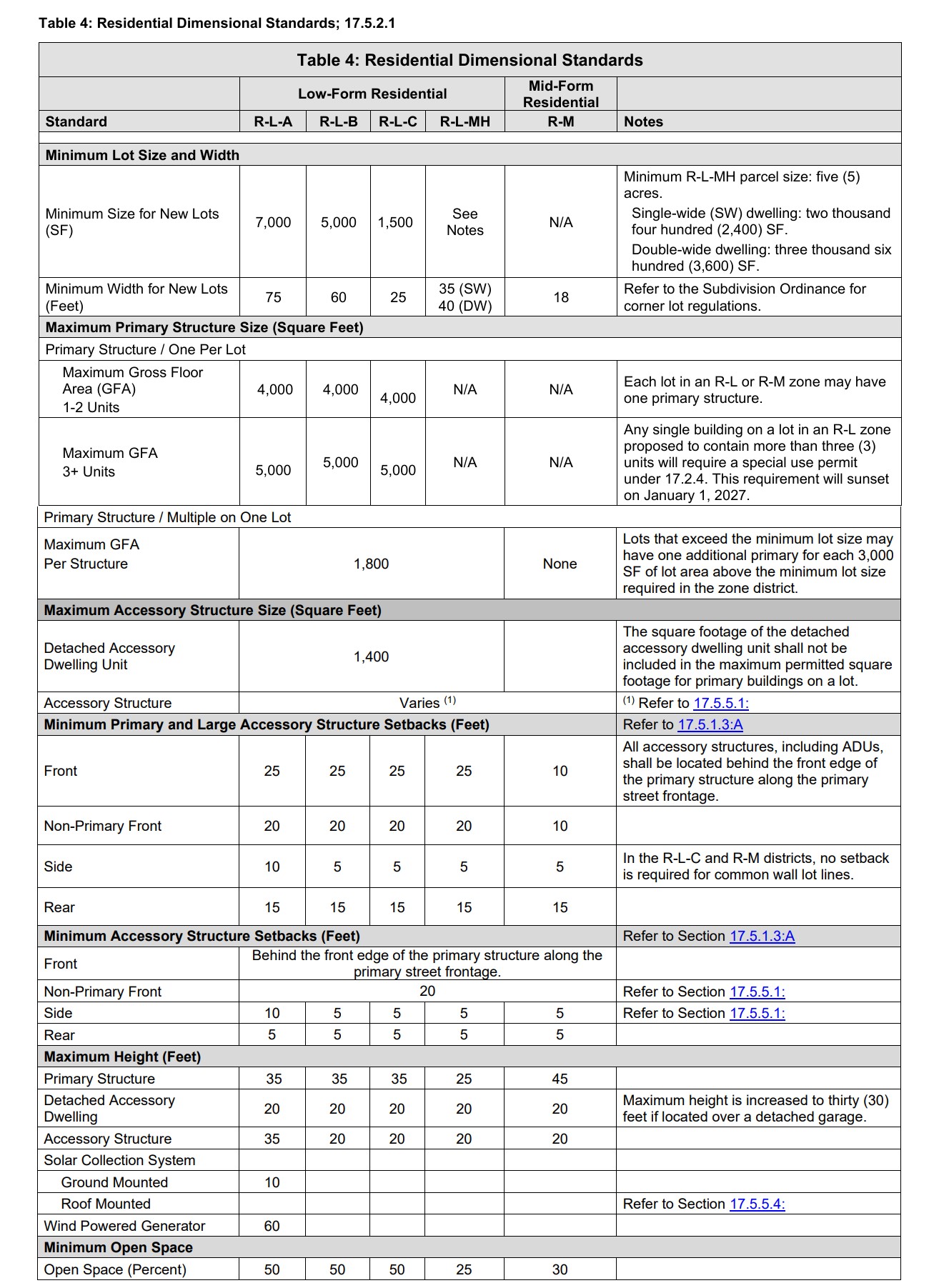
Link to full standards - approved in August (Article 5 - starts on page 97)
Here's what the standards mean.
- Minimum Lot Size and Width - A developer can purchase an existing home and subdivide the lot into individual parcels as long as they meet the minimum size standards below. In R-L-C districts, each subdivided lot would have to be at least 1,500 sq. ft. and 25 feet wide. A home could then be built on each lot. (An acre is 43,560 sq. ft.) Both R-L-A and R-L-B require larger minimum lot sizes and widths, making it more difficult to subdivide properties.
- Maximum Primary Structure Size - The "primary structure" is the house. In all of the R-L districts, a developer can buy a house and replace it with a building with multiple units. If it's a duplex, the maximum gross floor area is 4,000 square feet. if the building is divided into three or more dwelling units, the maximum GFA rises to 5,000 sq. ft.
- Maximum Accessory Structure Size - An accessory structure is either an ADU - basically a small house - or a shed or detached garage.
- Maximum Height - The main building on any lot can be up to 35 feet tall. The new ordinance, to comply with state law, allows an ADU (accessory dwelling unit) on any residential lot. ADUs are limited to a height of 20 feet.
- Minimum Open Space - There is a requirement that 50% of the lot be "open space." But the definition of open space appears to have loopholes. (We're trying to get some clarification of what that means.)
Email us at danielswelchester@gmail.com
©2026 Daniels Welchester Neighborhood Association